From Templates to Skills
How AI agents change the way we share engineering knowledge
Introduction
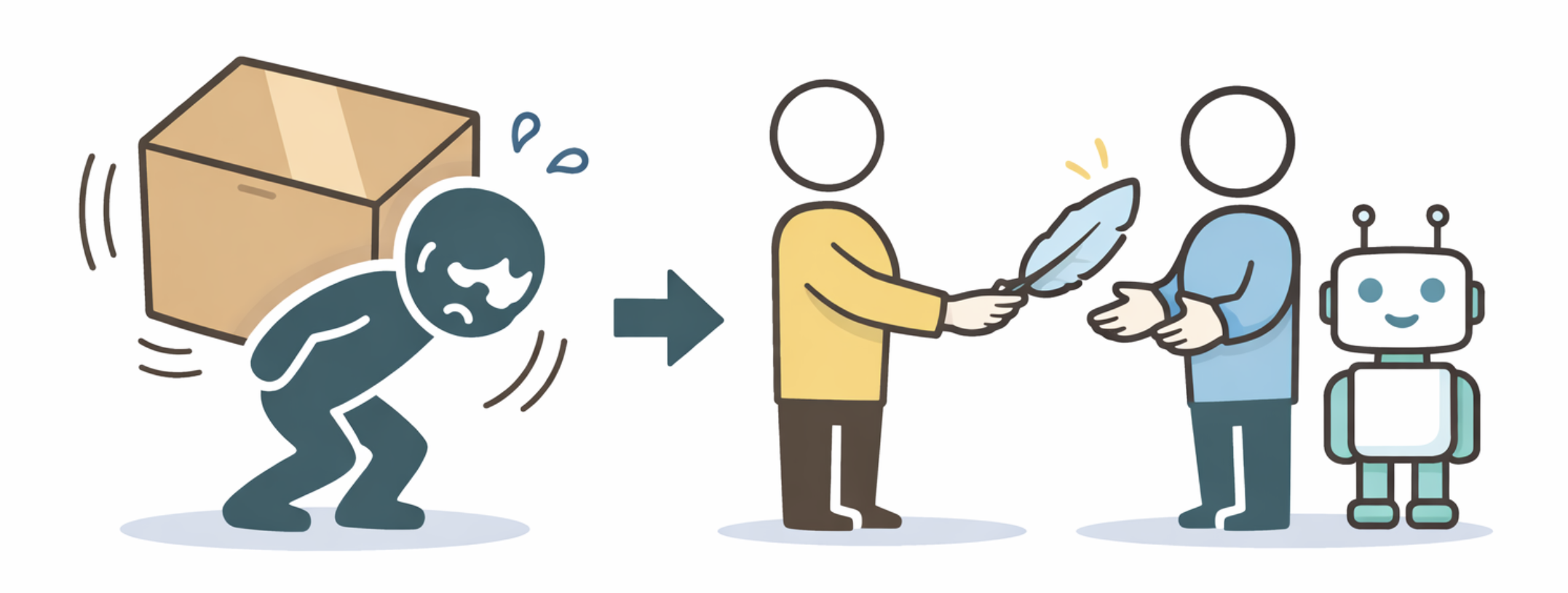
Sharing hard-earned software engineering lessons has always been hard. It requires both an upfront and a maintenance investment. Importantly, if you don’t strike a fine balance between approachable and useful, it may be for naught.
For the last four years, I maintained and iterated through several versions of azureml-scaffolding, a template/accelerator to fulfill the hypothesis-driven development promise: enable continuous experimentation without compromising production deployment for AI projects. I sank countless hours into it trying to make it more useful to more people but until now I struggled to find a balance of depth and accessibility. In this post, I explore why that changed.
The journey
It all started with the principles: A layered approach to MLOps. From these, we built what we now refer to as v1 of azureml-scaffolding. A starting point, a reference architecture that we hoped would marry rapid iteration loops in machine learning products and solid engineering practices that allowed making it into production without a phase change.
In v1, we tried to provide just enough to deliver on the promise while still enabling heavy customisation. As we believed, and still do, no two projects are made equal. This meant it started simple and significantly non-assuming. It worked, it was used in several projects and we learned from it. We started seeing patterns across projects and getting tired of reimplementing the same things over and over.
This motivated v2, in which we tried to bring all the learnings into a solution that offered even more. We added a full bash CLI, pipelines, data management, solid experimentation tracking and more. The use of uv for solid environment management. All the new features were useful, it all seemed like a nice evolution. But two things became apparent:
Each project needs its journey. Even if you know where you are going, every project’s specific needs require incremental adaptation. The more complex your starting point, the harder that becomes and the higher the probability that you just decide to start from scratch.
The principles got overshadowed. The scaffolding was built around clear guiding principles. These are more important than any specific implementation. The problem is that precisely because the implementation got huge, people understandably focused on the what and missed the why.
This essentially meant that fewer new people were actually leveraging the scaffolding as it was a pill too tough to swallow, and the ones that did easily got confused on how to use it. At the same time, the people that were familiar with the accelerator and did use it, myself included, never took the whole thing. We just copied the parts that we needed. Our solution had become what we swore to destroy.
Looking back, a fundamental tension becomes apparent: templates are either approachable or comprehensive. The more knowledge you pack in, the harder it is to transfer. With the tools at our disposal at the time, this was the best we could do and there was no obvious solution beyond loads of evangelizing and support.
What changed
Last October, Anthropic introduced agent skills. A skill, in its core, is simply a body of knowledge an agent has access to. The powerful idea behind them is, in my opinion, progressive disclosure: read only what you need, when you need it. Knowledge is layered.
This hinted at a solution to the tension we mentioned above. So we built v3 of the azureml-scaffolding. Now a skill instead of a template. To migrate it, we largely followed the skill-creator skill from Anthropic. The SKILL.md outlines the principles which should guide all generation. assets/ contains a modern version of v1 which is lean and self-contained, the core building blocks meant to be copied and then adapted. references/ includes advanced patterns, extensions (previously baked into v2) as markdown for when the user’s project is ready for them, with code snippets inlined to modify the core assets. In scripts/ we include complex executions of simple ideas (e.g., git shenanigans for good diffs in experiments) referenced by extensions and meant to be copied too. In general, we aim to use artifacts to anchor the generation, to ensure it steers toward our ideas and not the internet’s default. Be prescriptive on what truly matters and enable generation for customisation.
This works for two reasons:
The model does the plumbing. Before, the only way to support functionality was to fully implement it. That is why v2 became so large. Now, the model can take the principles and a lean starting point and expand into a working solution in context. Supporting pipelines went from a fully working template with multiple packages and associated bash scripts to a lean text file with mainly thinking principles.
The model becomes a teacher. The hardest part was always sharing the vision. Without having experienced the pains the template was solving, it was hard for people to understand how the pieces fit together and it often required a conversation with me. Now users can ask questions. Deciding what is the correct layer to register a trained model does not need to be documented explicitly at length. Interestingly, this means the model doubles as a reviewer, as it can be used to validate that changes adhere to principles.
The bigger picture
LLMs can be understood as a lossy compression of the internet. An internet which incidentally contains most of what there is to know about software engineering and related disciplines. Thus, in a way, the models serve as contextualized decompression engines of the knowledge we aim to share. This was not impossible before, but it required your reader to be knowledgeable enough to make this decompression themselves, therefore limiting the realistic audience. Ironically, these knowledgeable readers tended to know enough not to be willing to swallow the big pill. But now they get to pick and choose the small bits they value.
This means that the tension is largely gone: we no longer face the trade-off of comprehensive but scary or approachable but limited. We can focus on the key ideas with some examples to serve as direction and trust the model will be able to apply them. It is still early and requires some experimentation to find the right level of abstraction, but it works. And as the bar for sharing drops, maybe more people will.
I find it beautiful that skills (and LLM usage in general) align incentives: good writing pays off in good functionality. This means that most skills serve as learning material on their own, can easily be digested by human readers, and make it rather easy to bring a skill into your repo and adapt it at will.
For the people who want to become knowledgeable, there are unprecedented opportunities. The model is not only a decompressor, but a tutor. Infinitely patient, they can elaborate, answer questions and guide you through the material. While it is possible to just blindly let the LLM do the work, the keen will learn much faster.
Open Questions
There are still questions for which I don’t have answers yet:
- If we do not need to fully implement what we aim to share, how can we test it works? Especially when, like scaffolding, there are many extension patterns that interact with each other and create a significant number of possible permutations.
- What happens when we aim to compose the use of multiple adjacent skills?
- Do we have to test all of this? Can we? In the end, models are able to bootstrap solutions until they work but I’d bet that solid design and well-thought-out boundaries are as important as ever.
- What happens when the LLM misinterprets our ideas? Is this different than when a colleague does?
In any case, I am the happiest I have ever been with the state of the template, now a skill.